SECURITY AND COMPLIANCE
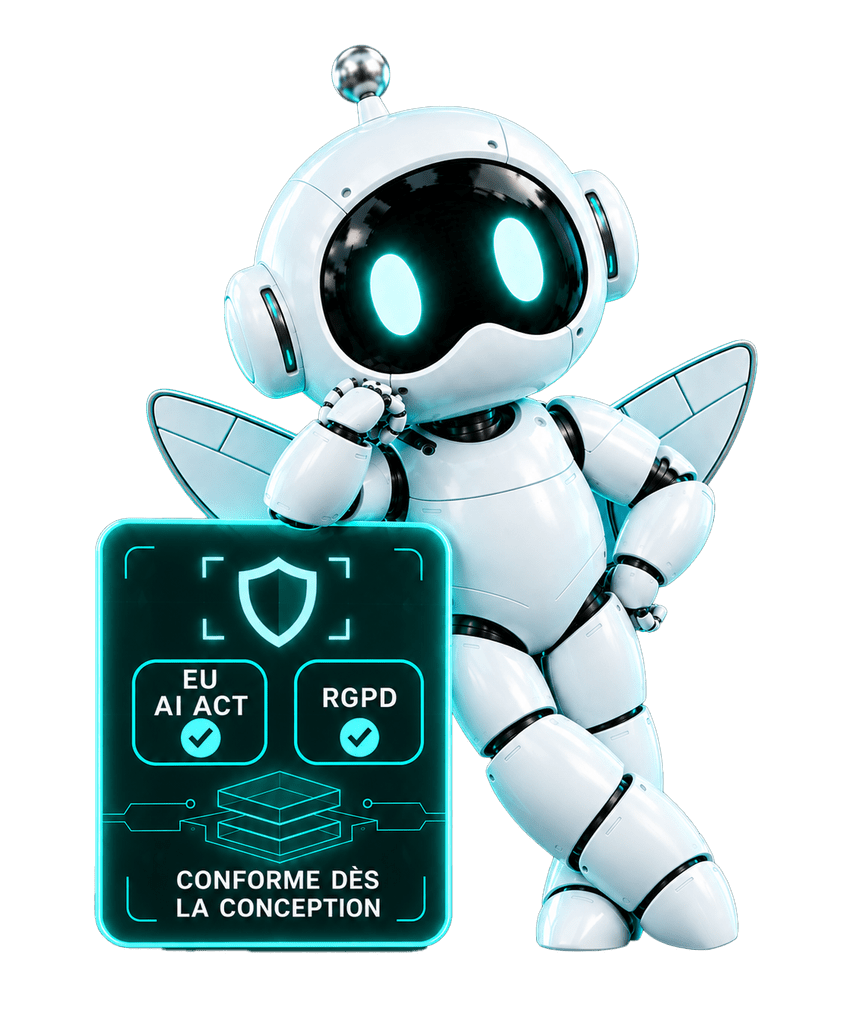
Compliant by design
nAIxxsens meets the requirements of the EU AI Act and the GDPR by design, with no last-minute rush to comply once the regulation comes into force.

What it means for you, depending on your role
AI compliance looks different depending on whether you use AI or sell it.
FOR CUSTOMERS
Your data, your decisions, under your control
✓
Your data never leaves your environment: on-premises or private cloud deployment.
✓
Nothing hidden: the platform runs on your side, in your own environment, under your rules. nAIxxsens explains every result and lets you replay every decision.
✓
You can trace, timestamp and explain every automated decision, including after the fact.
✓
You choose your AI model provider, with no vendor lock-in.
FOR RESELLERS
Compliance you can prove, not just promise
✓
You sell a platform that is compliant by design, not a compliance project still to come.
✓
You answer your customers’ audit questions with technical evidence, not promises.
✓
From 2027, you are also accountable for the choices your AI suppliers make on your behalf. nAIxxsens documents its own.
✓
A concrete differentiator against competitors on regulatory ground.
Compliance built from the start
nAIxxsens was designed from the very beginning to meet the requirements of the EU AI Act, rather than being brought into compliance after the fact once the regulation came into force. This requirement is therefore built into the platform’s architecture, not bolted on later to satisfy an audit committee.
GDPR compliance follows the same logic. Both regulations share common ground: data. An AI system that complies with the AI Act also respects, by design, the GDPR principles on personal data protection. That is why nAIxxsens addresses both regulations together, rather than a
Forecasting sales, optimising orders, spotting a duplicate invoice: these use cases fall into the lowest risk levels of the regulation. Yet nAIxxsens applies high-risk discipline to them. By choice, not by obligation.
Data hosting on the nAIxxsens platform
This question often comes before the functional ones: where does our data live, who can access it, and what happens if we change our minds? Here are straight answers.

On your premises, or with the hosting provider of your choice
On your servers, in your server room, or in the private cloud you have already chosen. nAIxxsens is installed wherever your data is allowed to be. No account to open with us, and not a single byte of your sales data goes anywhere else.

An installation, not a remote service
The platform is deployed in containers, in the environment you have chosen, and your teams keep control of the infrastructure, network and backups. Exact sizing is defined during the scoping phase, once your volumes are known.
Your database, or ours
nAIxxsens comes with its own ready-to-use database for a standalone installation. And if your IT department prefers to connect it to a managed database it already administers, that is supported and documented.

Close by default
On installation, nothing is exposed to the outside: only the web application is published, behind your proxy and your certificate. The calculation engines, model registry and databases cannot be reached from the internet. Connection secrets are encrypted at rest, and each service has its own keys.

One server, multiple entities
A single installation hosts several fully isolated workspaces. Useful for a group that keeps its subsidiaries separate, or for an integrator hosting its clients.
Four risk levels
to classify your use cases
The AI Act does not treat artificial intelligence as a single block :
obligations depend on the risk level of each use case, not on the technology itself.

Minimal risk
No specific obligations: spam filters, AI in video games. Most everyday use cases.

Limited risk
Transparency obligation: users must know they are interacting with AI. The typical level for conversational assistants and chatbots.

Unacceptable risk
Prohibited, with no route to compliance: widespread social scoring, cognitive behavioural manipulation. Outside the scope of ERP use cases.

High risk
The strictest obligations: technical documentation, effective human oversight, full traceability. Recruitment, credit scoring, HR: this is where your most sensitive use cases are concentrated.
Our rule of thumb: an AI use case is probably high-risk as soon as it helps make a decision that directly affects a person: a candidate, an employee, a customer applying for credit. It generally falls under limited risk when it optimises an internal flow without a direct decision about an individual.
Our teams support you on all your security and compliance matters
Talk to our experts today!
nAIxxsens, compliant by design
Each of these EU AI Act requirements was built in from the
platform’s design stage, not added in a rush ahead of a regulatory deadline.
1
Sovereignty and explainability
No black box to take on trust: the platform runs in your environment, every result can be explained and every decision can be replayed. Your teams, or a trusted third party, can verify what the system actually does.
2
Models that run on your side
The forecasting models are open source and run within your deployment: your sales, stock and supplier data never goes to a model provider. When generative AI comes into play, you choose the provider, including a sovereign option.
3
Proof before promise
Every forecast is evaluated before it is delivered. The result is shown in black and white, against your current method and against a naive baseline. You don’t take nAIxxsens at its word: you check for yourself.
4
Complete action log
Who did what, when, and with what result: every action, human or automated, is recorded in a log you can consult at any time. The full path of a decision can be reconstructed on demand.
5
Continuous monitoring
The platform detects drift in model behaviour and continuously checks the quality of incoming data, so that silent degradation does not skew the results.
6
Structured technical documentation
System description, risk assessment, oversight measures: the elements required by the regulation are produced by design, not written after the fact for an audit.
You won’t have to bring your AI system into compliance after the fact, under pressure from an inspection or a customer request : you will be compliant from day one of deployment.